

Reckless Russian Pilots Risk Igniting WW III
The seriousness of these encounters cannot be understated!

Since the first of the year, Russian fighter pilots have repeatedly engaged in markedly more irresponsible, aggressive, and threatening maneuvers around U.S. and NATO aircraft. The record shows that, more often than not, Russian fighter pilots have come precariously, and nervously, close to inciting a shooting war between the U.S., NATO and Russia.
Indeed, the seriousness of these encounters cannot be understated!
NATO members scrambled fighter jets nearly a dozen times in 21 days during July and August to intercept two-dozen Russian aircraft.
Less than a week ago, the BBC reported that a Russian fighter pilot deliberately fired missiles at a Royal Air Force surveillance plane. The American-made RC-135 Rivet Joint was fired on as it flew in international airspace over the Black Sea last year in an incident Russia said in a secret communique at the time was due to a “technical malfunction.”
The Boeing RC-135V/W Rivet Joint is a reconnaissance aircraft that supports theater and national level consumers with near real time on-scene intelligence collection, analysis, and dissemination capabilities.
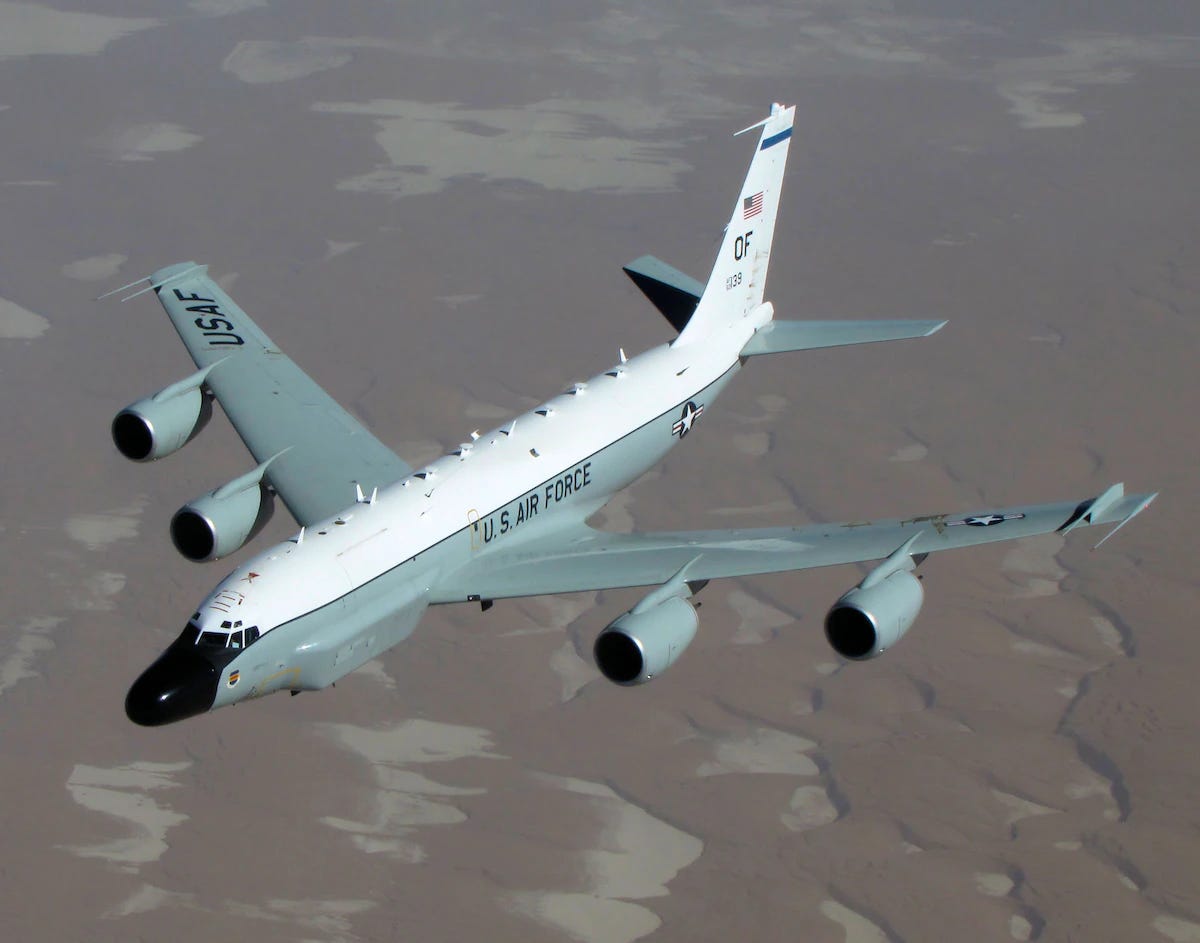
An extensively modified C-135, the Rivet Joint's modifications are primarily related to its on-board sensor suite, which allows the mission crew to detect, identify, and geolocate signals throughout the electromagnetic spectrum. The mission crew can then forward gathered information in a variety of formats to a wide range of consumers via Rivet Joint's extensive communications suite. The aircraft seats more than 30 people, including the cockpit crew, electronic warfare officers, intelligence operators, and in-flight maintenance technicians.
All Rivet Joint airframe and mission systems modifications are overseen by L-3 Communications under the oversight of the U.S. Air Force Materiel Command.
The BBC reported that intercepted communications picked up by the RC-135 revealed that the pilot of a Soviet-era Su-27 Flanker multi-purpose offensive fighter had fired on the NATO spy plane in September 2022 because he “thought he had been given permission to target the British aircraft following an ambiguous command from a Russian ground station.”
“This isn’t a damn kid’s game that’s being played up there”
“The pilot fired two missiles, the first of which missed rather than malfunctioned as claimed” by the British Ministry of Defense (MOD) in October 2022, when the incident took place, the BBC reported.
British officials downplayed the incident at the time. U.K. Defense Secretary Ben Wallace told Parliament a Russian jet had “released a missile in the vicinity of’’ a British plane, and that he had demanded an explanation from Russian Defense Minister Sergei Shoigu. Wallace said Russia’s response was that there had been “a technical malfunction of the Su-27 fighter.”
“We do not consider this incident to constitute a deliberate escalation on the part of the Russians, and our analysis concurs that it was due to a malfunction,” Wallace said.
But the BBC reported last week that “three senior Western defense sources with knowledge of the incident have since said that the Russian communications intercepted by the RAF RC-135 Rivet Joint [gave] a very different account from the official version.”
The British MOD stated that its “intent has always been to protect the safety of our operations, avoid unnecessary escalation, and inform the public and international community.” The MOD added, however, that “This incident is a stark reminder of the potential consequences of Putin’s barbaric invasion of Ukraine.”
A spokesman for Prime Minister Rishi Sunak said the prime minister was confident Wallace had not misled lawmakers but noted that “obviously there are limitations on some of the operational detail that can be put into the public domain.”
Among the classified materials that were leaked in 2022 and 2023 on the obscure invitation-only Discord chatroom called “Thug Shaker Central” by Jack Teixera, a 21-year-old member of the U.S. Air Force's 102nd Intelligence Wing, were documents that described the event as “a near shoot-down.”
“The incident was far more serious than originally portrayed, and could have amounted to an act of war," The New York Times reported, adding that an unnamed U.S. defense official described the incident “as really, really scary.”
In response to the leaked report of a “near shoot-down,” the British MOD stated that a “significant proportion of the content of these reports [from the documents] is untrue, manipulated, or both.”
“Eh, that’s probably not true,” intelligence officials said on background referring to the increasingly combative behavior exhibited by cavalier Russian pilots during their intercepts of U.S. and NATO aircraft.
CNN reported that an unnamed U.S. official had previously warned that Russian pilots may be trying to “provoke” the U.S. to “draw us into an international incident.”
Pentagon spokesman Brig. Gen. Pat Ryder called “on the Russian Air Force to cease this reckless activity.”
It wasn’t the first time that a Russian fighter pilot dangerously played chicken with an RC-135 strategic electronic reconnaissance plane. On June 19, 2017, a U.S. RC-135U flying in international airspace over the Baltic Sea was intercepted by a Russian Su-27 Flanker. The Pentagon said, “due to the high rate of closure speed and poor control of the aircraft during the intercept, this interaction was determined to be unsafe.”
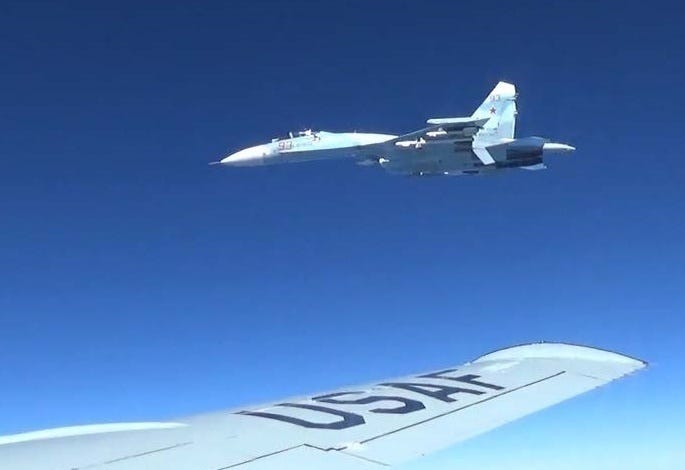
Six months later, on November 23, 2017, in international airspace near the Baltics, an interception of Russian aircraft was initiated because the aircraft did not broadcast the appropriate codes required by air traffic control and had no flight plan on file.
Only weeks later, on December 13, 2017, two Russian Navy Su-30 Flanker multirole all-weather operations fighter jets were intercepted in international airspace near the Baltics because the aircraft did not broadcast the appropriate codes required by air traffic control, and had no flight plan on file. Pilots from the 493rd Expeditionary Fighter Squadron executed the intercept in international airspace.
Two weeks ago, Ryder acknowledged that Russian fighters approached U.S. F-35 fighters and other Coalition aircraft over Syria seven times in August, and in several instances, treacherously flew within 1,000 feet of the American fighter jets.
Ryder said the Russian pilots flew “aggressive maneuvers, several of which were inside 1,000 feet,” which constituted actions he said were “unsafe and unprofessional,” and which “increase[d] the risk of miscalculation.
The most recent encounter took place on August 25, the Pentagon said.
Earlier, on Monday, August 14, 2023, two British Royal Air Force Quick Reaction Alert multi-role combat Typhoon fighters had to be scrambled to intercept two Russian long-range maritime patrol bombers as the two bombers transited north of the Shetland Islands within NATO’s northern air policing area.
The pilots of the two Typhoons intercepted and monitored the two Russian turboprop strategic bombers in international airspace until they passed north of the UK. Britain’s Quick Reaction Alert Force is based at RAF Lossiemouth (Northeast Scotland), RAF Coningsby (Eastern England), and the Falkland Islands (South Atlantic), and are ready to be scrambled in minutes to intercept threats to both the UK and NATO member countries.
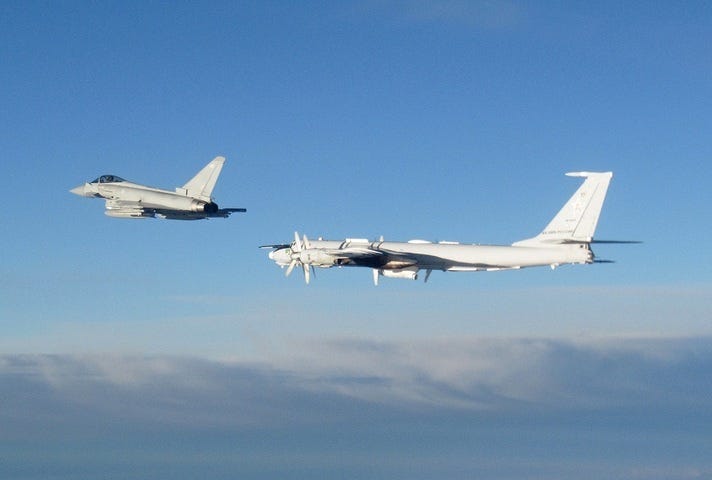
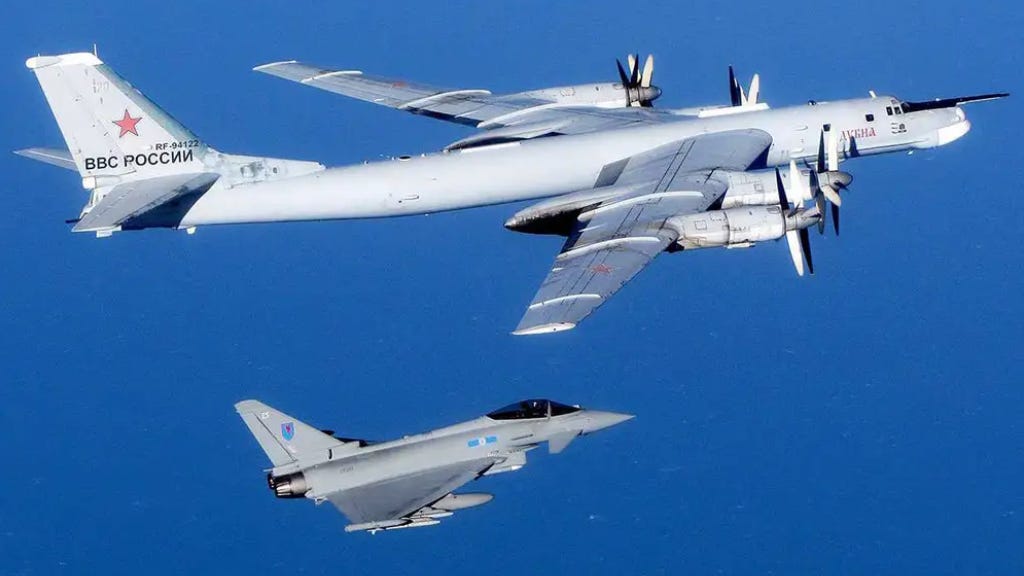
Both Russian bombers were Soviet-era designed aircraft which Russia continues to use for reconnaissance and anti-submarine warfare. They are the Tupelov-142 Bear-F, and the Tupelov-142 Bear-J.
The Tu-142 Bear-F is a Soviet-era Russian maritime reconnaissance and anti-submarine warfare aircraft that is derived from the Tu-95 turboprop strategic bomber. It was developed during the Cold War as an anti-submarine warfare aircraft. The Bear-F variant was specialized for long-range anti-submarine warfare operations.
The Tu-142 Bear-J serves as a command post and communications platform for communicating with submarines underwater. It was designed specifically as a doomsday plane to relay vital orders between Russia’s naval headquarters and a fleet of ballistic missile submarines in the event of a nuclear war. This variant of the Tu-142 was originally ordered in response to the U.S. Navy's Cold War-era communications aircraft.
This wasn’t the first time that Russian strategic bombers - and fighter jets - have skirted, or entered, British, NATO, and American territorial airspace. It happens with disturbing frequency … is on-going, and has increased in intensity, according to official Pentagon records and statements. But what is more disconcerting, and which occurs all too often, is these encounters involve maneuvers by Russian pilots – and naval commanders - that are unsafe, and come perilously close to miscalculation and collisions which could be misinterpreted as an overt act of war that runs the risk of quickly spiraling out of control.
More than a few table-top wargames involving such incidents have led to a wider conflict and, ultimately, WW III, senior Pentagon strategic intelligence analysts told me on background.
“This isn’t a damn kid’s game that’s being played up there,” declared a veteran U.S. intelligence officer whose domain is Russia’s military’s command and control systems and capabilities.
Shortly after the RAF Typhoon pilots were sent up to intercept the two Russian Tupelov bombers, a lone RAF Typhoon fighter pilot was drawn into a high stakes game of cat and mouse with three Russian fighter pilots who were threatening to cross into NATO airspace in a Cold War-era like encounter that served to underscore the amplified tensions between Russia and NATO. And, once again, demonstrated just how tenuous a line there is between peace and unnecessary conflict.
The British pilot said his Russian adversaries would slow down, then speed up for no reason, ducking in and out of cloud cover, which made it difficult for him to determine where they were, and in so doing, carelessly created a situation in which the slightest mistake could have been catastrophic.
“If I get caught up in the moment and accidentally collide with one of these aircraft, it could lead to an escalation into World War Three,” the British pilot said.
These encounters have been occurring with disturbing frequency, and what is especially alarming about them is the Russian pilots involved have engaged in maneuvers that are dangerous and increase the risk of miscalculation, collision … even war.
Two flagrant examples of the sorts of reckless maneuvers Russian pilots are known for had occurred just a few years earlier. Both incidents involved Russian fighter pilots dogging a U.S. Navy P-8A on April 19 and May 26, 2020.
During the April 19 encounter, a U.S. Naval Forces Europe-Africa/U.S. Sixth Fleet P-8A flying in international airspace over the Mediterranean Sea was intercepted by the pilot of Su-35 who engaged in a high-speed, high-powered maneuver that decreased his aircraft’s separation to within 25 feet directly in front of the P-8A, exposing it to the Su-35’s wake turbulence and exhaust.
During the May 26 encounter at an undisclosed location, the Pentagon disclosed that it was the third time in two months that Russian pilots had flown in “an unsafe and unprofessional manner” while intercepting a U.S. Navy P-8A Maritime Patrol and Reconnaissance Aircraft of the U.S. 6th Fleet.
In the May 26 incident, the P-8A was flying over the Eastern Mediterranean in international airspace when it was intercepted by two Russian Su-35 aircraft over a period of 65 minutes. The Navy said “the intercept was determined to be unsafe and unprofessional due to the Russian pilots taking close station on each wing of the P-8A simultaneously, restricting the P-8A’s ability to safely maneuver. The unnecessary actions of the Russian Su-35 pilots were inconsistent with good airmanship and international flight rules and jeopardized the safety of flight of both aircraft.”
While the Russian aircraft was operating in international airspace, the Navy acknowledged, it also said the “interaction was irresponsible. We expect them to operate within international standards set to ensure safety and to prevent incidents, including the 1972 Agreement for the Prevention of Incidents on and Over the High Seas (INCSEA). Actions like these increase the potential for midair collisions.”
In all cases, the Navy said, “the U.S. aircraft were operating in international airspace, consistent with international law, with due regard for safety of flight, and did not provoke this Russian activity.”
The Sukhoi Su-35 is the designation for two improved derivatives of Russia’s Su-27 air-defense fighter.
Also in April, 2020, two Belgian F-16 Fighting Falcon multirole fighters assigned to NATO’s Baltic Air Policing mission launched from Šiauliai Air Base in Lithuania to intercept two Su-24 Fencer attack jets, one Su-27 Flanker air superiority fighter, and one Su-30 Flanker-C multirole fighter as the Russian pilots conducted risky low passes over the USS Donald Cook, an Arleigh Burke-class missile destroyer, while it was operating in the Baltic Sea off the coast of Lithuania.
The intercepts were ordered after the Russian pilots refused to respond to hails by the USS Donald Cook.
Almost four years earlier to the day, on April 12, 2016, the
pilots of two Sukhoi Su-24 attack aircraft had flown low over the USS Donald Cook as it was forward deployed to Rota, Spain conducting a routine patrol in the U.S. 6th Fleet area of operations in support of U.S. national security interests in Europe.
On August 28, 2020, Russian pilots flying Su-27 Flankers intercepted a U.S. Air Force B-52 bomber that was carrying out routine operations in international airspace over the Black Sea. The Russian pilots dogged the B-52 in an unsafe manner while crossing within 100 feet of its nose multiple times at co-altitude, and while in afterburner, creating turbulence and restricting the B-52 pilots’ ability to maneuver.
“Actions like these increase the potential for midair collisions, are unnecessary, and inconsistent with good airmanship and international flight rules,” Gen. Jeff Harrigian, then U.S. Air Forces in Europe-Air Forces Africa commander, said at the time. “While the Russian aircraft were operating in international airspace, they jeopardized the safety of flight of the aircraft involved. We expect them to operate within international standards set to ensure safety and prevent accidents.”
“Our B-52 Stratofortress aircraft was conducting routine operations in international airspace exercising our freedom of navigation and overflight,” Harrigian stated, adding, “The U.S. Air Force routinely operates aircraft in the region in accordance with recognized international safety standards as prescribed in International Civil Aviation Organization rules of flight.”
Days later, another Russian Su-27 pilot stalked yet another B-52 into Danish airspace. The Su-27 pilot turned back when two Danish fighter jets were scrambled to intercept him.
“The incident is the first of this kind for several years, and indicates a new level of Russian provocative behavior,” NATO said.
This kind of heedless behavior by Russian fighter pilots isn’t new, however. Two years earlier, on January 29, 2018, a U.S. Navy EP-3 Aeries – the U.S. Navy’s only land-based multi-intelligence reconnaissance aircraft – was flying in international airspace over the Black Sea when it was intercepted by a Russian Su-27 in an interaction the U.S. Navy decried as unsafe. The Su-27 pilot closed to within five feet of the EP-3 and crossed directly through its flight path, causing the pilots of the EP-3 to have to fly through the Su-27’s jet wash. Disturbingly, the interception lasted a harrowing two hours and 40 minutes.
Nine months later, on November 5, another U.S. Navy EP-3 was flying over the Black Sea when it, too, was intercepted by a Russian Su-27 pilot who proceeded to make a high-speed pass directly in the EP-3’s path, putting its crew’s lives at risk.
The Su-27 pilot then went on to make one more dangerous close pass, closing with the EP-3 and kicking in the Flanker’s afterburner while making a hard bank before flying away. The crew of the EP-3 reported turbulence following the first pass, and vibrations from the second.
The U.S. Navy decried the Su-27 pilot’s maneuvers as “irresponsible,” adding that “While the Russian military is within its right to exercise within international airspace, this interaction was irresponsible. We expect them to behave within international standards set to ensure safety and to prevent incidents, including the 1972 Agreement for the Prevention of Incidents On and Over the High Seas (INCSEA). Unsafe actions increase the risk of miscalculation and potential for midair collisions.”
Less than a year earlier, another Navy EP-3 Aries flying in international airspace over the Black Sea had also been intercepted by a Russian Su-27 in an interaction that also had been declared unsafe. The Pentagon emphasized that because the Russian pilot closed his fighter to within five feet of the EP-3, crossing directly through its flight path, the EP-3 was forced to fly through the Su-27's jet wash.
The U.S. Navy declared that the Russian pilot’s maneuvers constituted “unsafe actions [that] increase[d] the risk of miscalculation and midair collision.”
On April 4, 2020, a U.S. Navy P-8A Maritime Patrol and Reconnaissance Aircraft flying in international airspace over the Mediterranean was dangerously intercepted by the pilot of a Su-35 Flanker in an encounter the Pentagon also condemned as unsafe and unprofessional.
The Su-35’s pilot carried out a high-speed, high-powered maneuver that decreased his aircraft’s separation to within 25 feet directly in front of the P-8, exposing the Navy surveillance plane to the Su-35’s wake.
Then, for the third time in two months, on May 26, 2020, Russian pilots again flew in an unsafe and unprofessional manner while intercepting another U.S. Navy P-8A flying in international airspace over the Mediterranean.
In that incident, which lasted nearly two hours, the pilots of two Su-35 Flankers simultaneously came dangerously close on each wing of the P-8A, restricting the P-8A pilots’ ability to safely maneuver.
The Navy said this incident followed two earlier unsafe interactions in April 2020 over the same waters.
On March 14, 2023, two Russian Su-27 pilots performed an unsafe and unprofessional intercept of a U.S. Air Force MQ-9 drone operating in international airspace over the Black Sea. The two Russian pilots dumped fuel on the MQ-9, striking the drone’s propeller in the process, causing the drone’s pilot to have to bring the drone down in international waters.
The Russian Ministry of Defense denied that its Su-27 pilots engaged in reckless actions against the drone which, Moscow interestingly admitted, would have been an act of war if Russian aircraft had collided with the American drone. Moscow said its pilots never came into contact with the drone, declaring instead that the MQ-9 crashed due to “sharp maneuvering.”
Pentagon spokesman Pat Ryder said the Russian Su-27 that clipped the MQ-9 likely was damaged. The Su-27 reportedly landed safely.
Two weeks later, on March 21, 2023, the Russian Ministry of Defense announced one of its Su-35 pilots had intercepted two U.S. B-52H long-range strategic bombers in international airspace over the Baltic Sea, and provided video to substantiate its claim. The dramatic video purportedly was taken by a camera onboard one of the Su-35s.
Dmitry Peskov, Russian President Vladimir Putin’s longtime trusted spokesman, told reporters during a conference call that U.S. B-52 flights near Russian territorial airspace “create additional tensions.”
Although the video unusually made public by the Kremlin obviously does not show the Russian Su-35 pilots engaging in reckless flying near either of the cumbersome bombers, sources Unauthorized Disclosures spoke to said the Russian pilots did in fact engage in the kind of dangerous maneuvers that other Russian fighter pilots have engaged in, as is detailed in this report.
Neither the U.S. Air Force nor the Pentagon initially acknowledged Russia’s claim. But when pressed during a Pentagon briefing, Ryder said “at no point did the B-52s make contact with Russian aircraft,” adding that the Kremlin’s account of the intercept was … “inaccurate information.”
Less than two weeks later, on April 2, 2023, a Russian pilot flying a Su-35 performed an unsafe intercept of a U.S. F-16 operating in airspace that U.S.-Russian protocols recognize as Coalition-controlled airspace over Syria. The Russian pilot had not been deconflicted when he entered the airspace.
The Pentagon said the incident followed a pattern of dangerous actions by Russian pilots while interacting with U.S. and Coalition aircraft, and that these aggressive actions demonstrated lack of competence and could lead to miscalculation and unintended escalation.
Two weeks later, on April 18, 2023, the pilot of another Su-35 who violated Coalition Airspace in Syria was intercepted by a U.S. fighter from an air base in the region. The Su-35 pilot maneuvered unprofessionally within 2,000 feet of the U.S. fighter, violating standing deconfliction protocols, the Pentagon said, pointing to the fighter’s onboard camera.
Less than three weeks later, on May 29, 2023, the Russian Ministry of Defense announced that the pilots of a Su-27 and a Su-30SM had intercepted two U.S. Air Force B1-B Lancer strategic bombers flying in international airspace over the Baltic Sea. The Defense Ministry said in both instances its fighter pilots were scrambled to “prevent a violation of its border,” and were carried out in strict accordance with international rules.
Initially, the Pentagon was mum about the Kremlin’s claims, but when pressed, Ryder said during a news briefing that two U.S. B-1 bombers had indeed been “operating in Europe as part of a scheduled bomber rotation.” and that they “were interacted with safely and professionally by the Russian aircraft.” Ryder aid at the time that he had “no additional details to add.”
Two months later, on July 4, 2023, the Russian pilots of two more Su-35 fighter jets closed in on another U.S. MQ-9 drone flying over Syria, this time deploying parachute flares in the drone’s flight path, forcing the MQ-9’s pilot to take evasive maneuvers.
One of the Russian pilots positioned his Su-35 in front of the MQ-9 and engaged his aircraft’s afterburner, dynamically increasing speed and air pressure and thereby reducing the MQ-9 operator’s ability to safely operate the drone.
Less than three weeks later, on July 23, a Russian fighter pilot flew dangerously close to yet another U.S. MQ-9 before deploying flares from a position directly above the drone while the drone was on a counter-ISIS mission in Syria. One of the flares struck the drone, severely damaging its propeller. Despite the damage, the pilot was able to return the drone back to its home base.
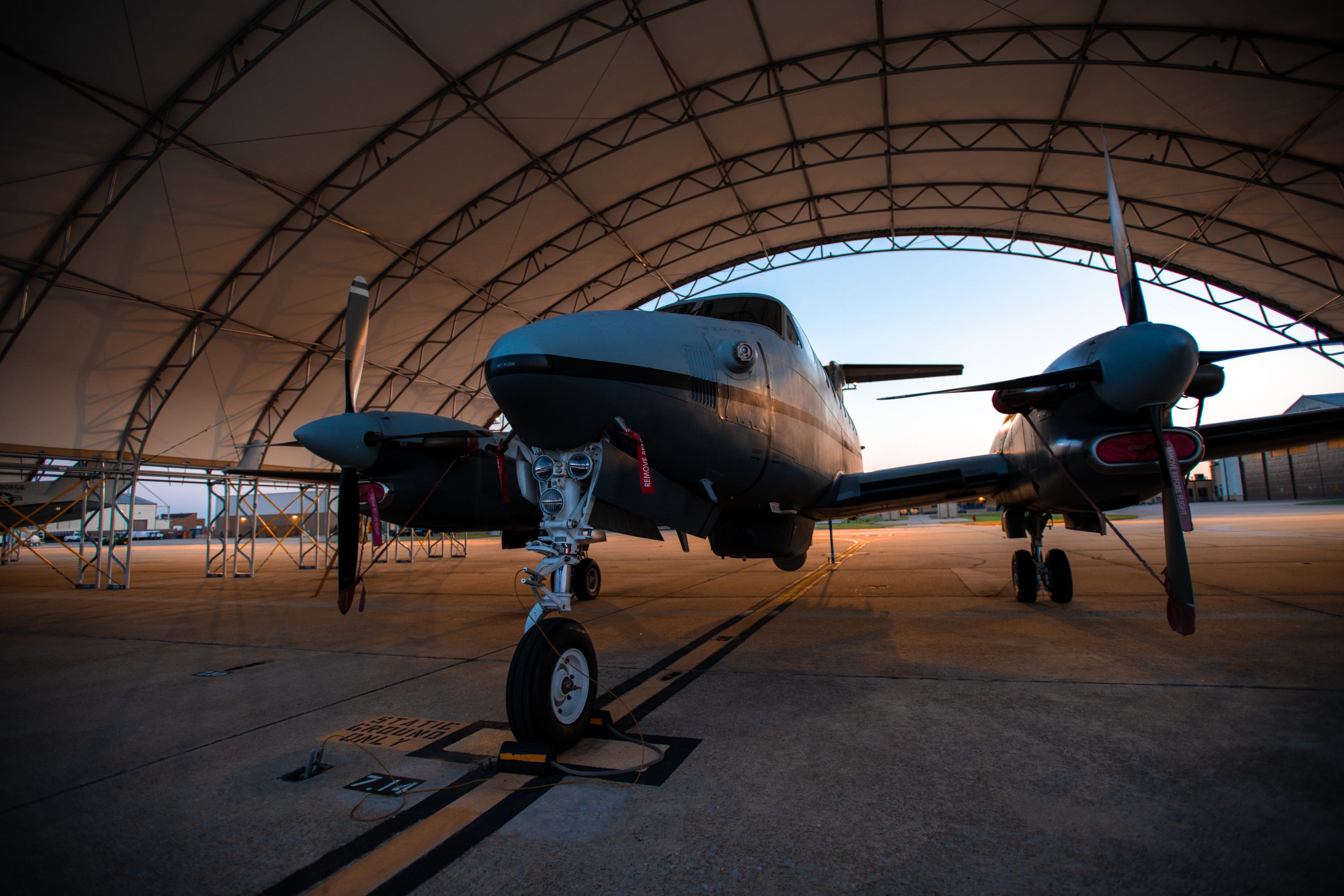
A similar incident had taken place on July 17 when the pilot of a Su-35 flew dangerously close to a U.S. MC-12 twin-engine turboprop aircraft that’s routinely used by special operations forces; in this instance, conducting surveillance in support of counterterrorism operations in Syria.
As in the earlier incidents, the Russian pilot forced the MC-12’s pilots to have to fly thru the wake caused by the Russian aircraft, which U.S. officials once again said constituted a new level of unsafe behavior that could result in an accident or loss of life.
U.S. officials also said the incident constituted a significant escalation in what had been a string of threatening encounters between U.S. and Russian aircraft.
Reckless behavior against U.S. aircraft hasn’t been confined to Russian pilots. On July 19, 2019, a Navy EP-3 Aries flying in international airspace over the Caribbean Sea was “aggressively shadowed” by the pilot of a Venezuelan Su-30 Flanker who had taken off from an airfield 200 miles east of Caracas. Pentagon officials said the Su-30 pilot approached the EP-3 in an unprofessional manner that brought him to an unsafe distance from the Navy spy plane, jeopardizing its crew.
Reckless and dangerous behavior by Russians isn’t limited to their pilots. The commanders of Russian naval ships also have engaged in menacing maneuvers.
On June 7, 2019, while operating in the Philippine Sea, the Russian Udaloy-class Destroyer DD 572 made an unsafe maneuver against the USS Chancellorsville by closing to within 50 to 100 feet, putting the safety of both boats and crew at risk.
The USS Chancellorsville, the U.S. Navy’s 16th Ticonderoga-class guided-missile cruiser which was renamed the USS Robert Smalls earlier this year, was recovering its helicopter on a steady course and speed when the Russian destroyer maneuvered from behind and to the right of the Chancellorsville, then accelerated and closed to an unsafe distance, forcing the commander of the Chancellorsville to execute all engines back full and to maneuver to avoid collision.
The Navy said the Russian commander’s actions were unsafe and unprofessional, and not in accordance with the International Regulations for Preventing Collisions at Sea “Rules of the Road” that are internationally recognized maritime customs.
Seven months later, on January 9, 2020, while conducting routine operations in the North Arabian Sea, the USS Farragut, an Arleigh Burke-class destroyer, was aggressively approached by the Ivar Khurs, one of two Russian Yury Ivanov-class intelligence collection ships assigned to Russia’s Black Sea Fleet.
The Farragut sounded five short blasts, the international maritime signal for danger of a collision, and requested the Russian ship to alter course in accordance with international rules of the road.
The Ivar Khurs initially refused, but ultimately altered course and the two ships opened distance from one another. But while the Russian ship acted, the initial delay in complying with international rules while it was making an aggressive approach, had increased the risk of collision.
According to several strategic intelligence analysts I talked to, there have been more recent “near misses,” both in the air, and at sea. And as one of the analysts bluntly put it: “If this continues … well, I really need not tell you what’s going to happen, do I!”
No. No, he doesn’t.